How Structured Investments Work
Structured investments align with investor objectives across four elements:
- Payment Type – Single maturity payment or periodic coupons.
- Protection Level – Full, partial, or contingent protection.
- Term Length – Usually one to five years, sometimes with early call features.
- Underlier – Performance is linked to a reference asset, enabling a specific objective or market view.
Common Structured Investment Strategies
The most common types of structured investments are:
- Market-Linked Notes – A note where the principal amount is invested in a debt obligation of the issuer with returns linked to the performance of an underlying asset.
- Market-Linked CDs – A note where the principal amount is insured by a FDIC bank with returns linked to the performance of an underlying asset. Market-linked notes offer higher returns but carry the credit risk of the issuer.
Structured notes can help investors pursue specific objectives—such as income or growth—or express a market view that complements their overall portfolio:
| Objective |
What it Means |
| Income |
Periodic coupon payments based on the performance of the underlying asset with some principal protection. |
| Growth |
Potential to participate in gains of the underlying asset with full or partial downside protection. |
In addition, different types of protection are offered:
- Full: Principal is returned at maturity (subject to issuer credit).
- Partial: Absorbs some losses up to a buffer; beyond that, losses may match the underlier.
- Contingent: Provides protection unless the underlier falls beyond a set level, after which losses can be one-for-one.
Benefits of Structured Investments
- Potential for Return Enhancement – Upside participation or yield enhancement with downside principal protection. Upside may be leveraged (e.g., >1× participation) or capped, so returns can be limited even in strong markets.
- Downside Protection – Structures can limit losses, aligning with an investor’s risk tolerance.
- Customization – Tailored exposure to specific assets or strategies.
Implementation Insight:
Matching product features —such as coupon type, underlier, and term —to an investor’s outlook and risk profile is critical to aligning expectations with outcomes.
Key Risk Considerations
- Liquidity Risk – Typically buy-and-hold investments; issuers/dealers may not provide liquidity and early sale prices can be discounted due to embedded fees.
- Credit Risk – Principal and coupon depend on the issuer’s creditworthiness and not guaranteed by government insurance (except for FDIC-insured CDs).
- Underlier Dependence – Returns tied to reference assets, which may not behave as expected.
- Complexity & Fees – Structures can be intricate, with embedded costs that affect early sale value.
Implementation Insight:
Always review the offering materials carefully for terms, fees, caps, participation rates, fees, liquidity provisions, and issuer strength.
Hypothetical Example
Goal: An investor wants to grow money by investing in emerging markets but also wants some protection if those markets fall.
Possible Solution: A 4-year note linked to the MSCI Emerging Markets Index.
- If the market goes up, the investor earns 1.5 times the market’s gain (up to a cap).
- If the market falls, the investor is protected from the first 20% of losses.
- If the market drops more than 20%, the investor starts to lose money beyond that point.
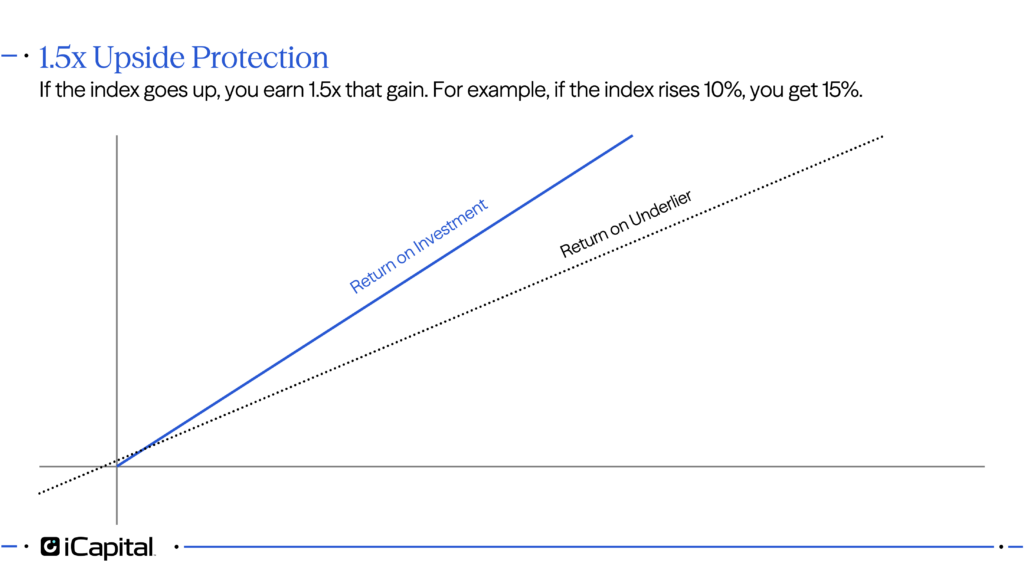
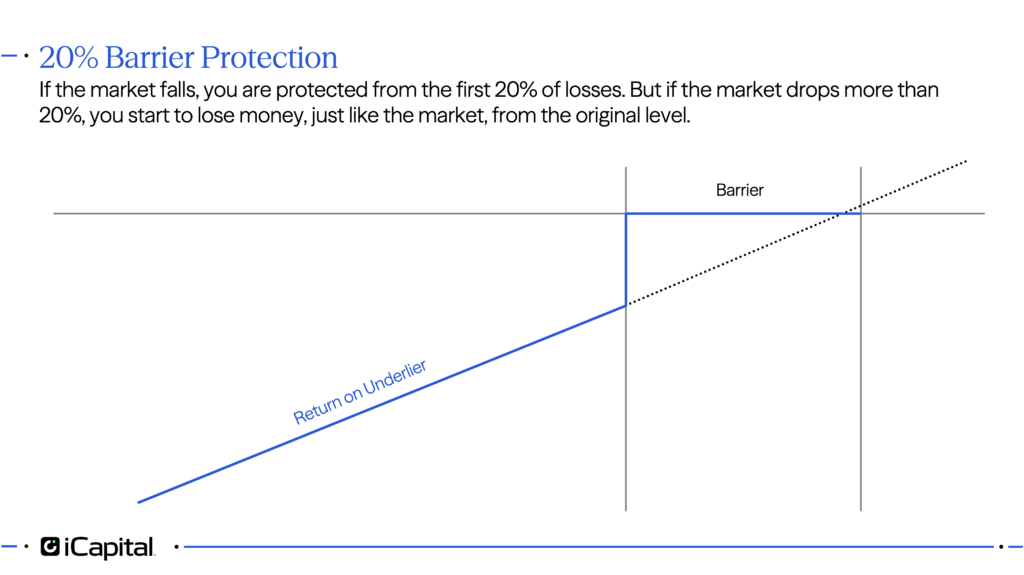
The visuals included are hypothetical examples. They do not reflect any specific structured investment and are solely intended to help illustrate how different payment and protection methods work.
Structured Investments: Myth vs. Fact
| Myth |
Fact |
| Structured investments are one-size-fits-all |
Notes are customizable (term, underlier, protection, payout). |
| They always require taking on full market risk |
Protection can be full, partial, or contingent; risk depends on terms. |
| Only equity-linked structures exist |
Underliers can include indices, ETFs, single stock, commodities, rates FX. |
IMPORTANT INFORMATION
The material herein has been provided to you for informational purposes only by Institutional Capital Network, Inc. (“iCapital Network”) or one of its affiliates (iCapital Network together with its affiliates, “iCapital”). This material is the property of iCapital and may not be shared without the written permission of iCapital. No part of this material may be reproduced in any form, or referred to in any other publication, without express written permission of iCapital.
This material is provided for informational purposes only and is not intended as, and may not be relied on in any manner as, legal, tax or investment advice, a recommendation, or as an offer or solicitation to buy or sell any security, financial product or instrument, or otherwise to participate in any particular trading strategy. This material does not intend to address the financial objectives, situation, or specific needs of any individual investor. You should consult your personal accounting, tax, and legal advisors to understand the implications of any investment specific to your personal financial situation.
ALTERNATIVE INVESTMENTS ARE CONSIDERED COMPLEX PRODUCTS AND MAY NOT BE SUITABLE FOR ALL INVESTORS. Prospective investors should be aware that an investment in an alternative investment is speculative and involves a high degree of risk. Alternative investments often engage in leveraging and other speculative investment practices that may increase the risk of investment loss; can be highly illiquid; may not be required to provide periodic pricing or valuation information to investors; may involve complex tax structures and delays in distributing important tax information; are not subject to the same regulatory requirements as mutual funds; and often charge high fees. There is no guarantee that an alternative investment will implement its investment strategy and/or achieve its objectives, generate profits, or avoid loss. An investment should only be considered by sophisticated investors who can afford to lose all or a substantial amount of their investment.
iCapital Markets LLC operates a platform that makes available financial products to financial professionals. In operating this platform, iCapital Markets LLC generally earns revenue based on the volume of transactions that take place in these products and would benefit from an increase in sales for these products.
The information contained herein is an opinion only, as of the date indicated, and should not be relied upon as the only important information available. Any prediction, projection, or forecast on the economy, stock market, bond market, or the economic trends of the markets is not necessarily indicative of the future or likely performance. The information contained herein is subject to change, incomplete, and may include information and/or data obtained from third-party sources that iCapital believes, but does not guarantee, to be accurate. iCapital considers this third-party data reliable, but does not represent that it is accurate, complete, and/or up to date, and it should not be relied on as such. iCapital makes no representation as to the accuracy or completeness of this material and accepts no liability for losses arising from the use of the material presented. No representation or warranty is made by iCapital as to the reasonableness or completeness of such forward-looking statements or to any other financial information contained herein.
Securities products and services are offered by iCapital Markets, an SEC-registered broker-dealer, member FINRA and SIPC, and an affiliate of iCapital, Inc. and Institutional Capital Network, Inc. These registrations and memberships in no way imply that the SEC, FINRA, or SIPC have endorsed any of the entities, products, or services discussed herein. Annuities and insurance services are provided by iCapital Annuities and Insurance Services LLC, an affiliate of iCapital, Inc. “iCapital” and “iCapital Network” are registered trademarks of Institutional Capital Network, Inc. Additional information is available upon request.
©2026 Institutional Capital Network, Inc. All Rights Reserved.